What workshop management software actually solves for automotive workshops in UAE

Updated: Jun 11
Mansoor runs a 12-bay workshop in Al Quoz, Dubai. On paper, his operation looks healthy - 25 vehicles daily, five technicians, a steady stream of Range Rovers and Toyota Land Cruisers through the doors.
Yet every month, his accountant finds the same gaps.
A brake pad set installed but never invoiced. Three hours of diagnostic labor missing from Friday's final bill. A technician who spent 40 minutes between jobs waiting for the service advisor to finish handwriting the next repair order.
"These aren't disasters," Mansoor told us. "They're quiet leaks. And they add up."
This is the reality for hundreds of independent workshops across Dubai, Abu Dhabi, and Sharjah. The UAE's automotive service market is growing - vehicle ownership rose 4.2% year-over-year according to recent RTA data - but operational infrastructure hasn't kept pace.
When your workshop handles 15 to 30 vehicles daily, manual processes don't just slow you down. They systematically erode profit in ways that don't show up on a single job card, but definitely appear in your monthly P&L.
Where Manual Processes Start Breaking Down (And Why It Matters in the UAE)
The Walk-Around Management Problem
In a busy Dubai workshop, the service advisor becomes a human notification system. They walk. They ask. They wait.
"Which bay is the Land Cruiser in?"
"Did we already replace the AC compressor on the Patrol?"
"Is Khalid's team done with the brake job or still diagnosing?"
Without a central system, workshop managers physically traverse the floor to extract information that should be visible in seconds. In UAE summers, this isn't just inefficient - it's physically demanding and wastes time that could go toward revenue-generating activities.
The real cost isn't the walking. It's the decision delay. When you don't know which technician is available now, you don't assign the next job now. Those five-minute gaps between assignments accumulate across eight hours and five technicians. Do the math.
The Phantom Parts Problem
Here's a scenario that plays out in Sharjah workshops weekly:
A technician pulls a set of brake pads from inventory to complete a job. The customer is waiting. The pressure is on. He installs the parts, returns to the bay, and intends to write it on the job card later.
Later becomes tomorrow. Tomorrow becomes never. The invoice goes out with labor charges but no parts line.
At AED 180 per brake pad set, happening twice weekly, that's roughly AED 18,720 in unbilled inventory annually. For one part category. In one workshop.
The workshops that solve this aren't just buying software - they're specifically fixing how they handle auto spares inventory management for UAE garages where the heat, the pace, and the pressure make paper tracking impossible.
Paper systems rely on memory and immediate documentation - two things that fail precisely when workshop pressure peaks.
The Fragmented History Trap
Repeat customers are the lifeblood of UAE independent workshops. The expatriate population turns over, but vehicles stay. A well-maintained Nissan Patrol might see the same workshop for eight years across three different owners.
But if the service history lives in a filing cabinet - or worse, the previous service advisor's memory - every return visit starts from zero.
Technicians re-diagnose issues already addressed six months prior. Customers repeat explanations. Trust erodes because the workshop cannot demonstrate continuity.
How Digital Workshop Systems Change the Daily Rhythm
Workshop management software doesn't merely digitize existing chaos. It imposes structure that prevents chaos from forming.
From Walking to Watching
With a digital system, the workshop manager's phone or tablet becomes the operational dashboard.
Bay 3: Land Cruiser, brake job, 70% complete, technician Ahmed
Bay 5: Patrol, AC diagnosis pending, awaiting customer approval
Bay 1: Empty, technician Khalid available
Real-time visibility eliminates the walk-around. It enables proactive decisions - reassigning Khalid to a waiting job before he even leaves his bay, rather than after a ten-minute gap.
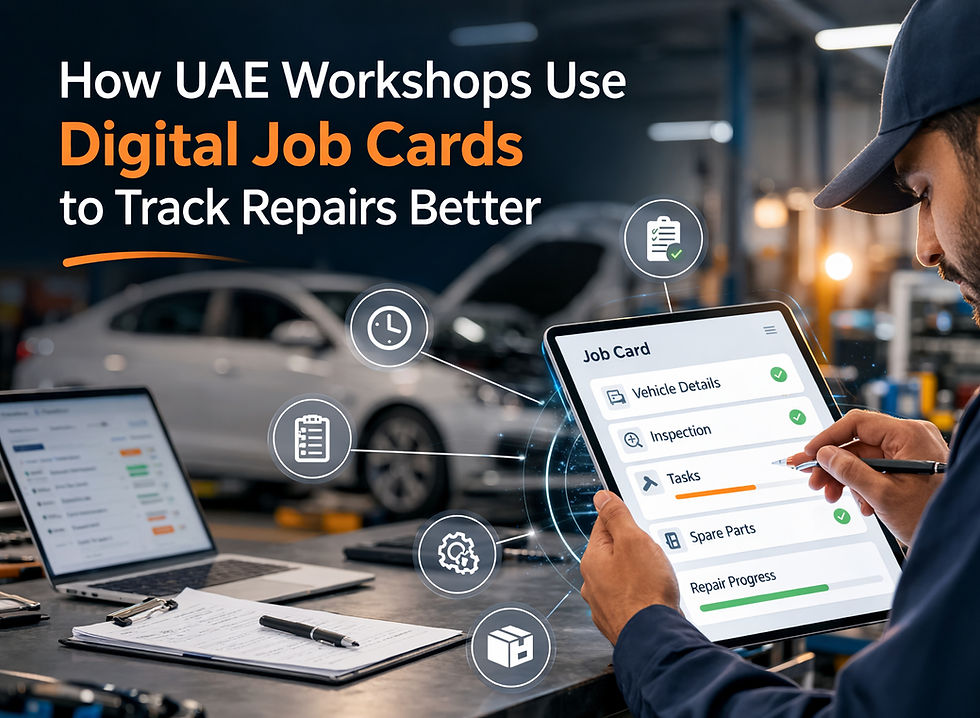
Most workshops don't jump into full digitization overnight. They start with the basics - replacing handwritten cards with digital job cards that UAE workshops use to track repairs better, then expand from there once they see the time savings.
Connected Inventory and Billing
When a technician adds a part to a digital job card, three things happen simultaneously:
The part deducts from inventory records
The part line appears on the customer invoice
The cost calculates against job profitability
There's no "remember to bill later" because later is automatic. The system closes the gap between usage and invoicing that paper processes cannot bridge.
Continuous History
Every repair, part, and labor line accumulates in the vehicle's digital record. When the Patrol returns in six months, the technician sees:
Previous repairs with dates
Parts replaced and their warranty status
Labor patterns that might indicate emerging issues
This isn't convenience. It's competitive advantage in a market where customers have choices and loyalty must be earned repeatedly.
Why UAE Workshops Specifically Benefit
The UAE automotive service market has unique characteristics that amplify the value of structured systems:
High vehicle value density. Workshops regularly service vehicles worth AED 200,000-500,000. Customers paying premium prices expect premium documentation and transparency. Paper job cards don't project professionalism.
Multi-cultural workforce coordination. Technicians and service advisors often speak different native languages. Digital systems with standardized fields reduce miscommunication that verbal handoffs create.
Regulatory documentation requirements. RTA compliance and warranty documentation increasingly favor digital records. Paper archives deteriorate in UAE humidity and are difficult to search retrospectively.
Rapid scaling pressure. Workshops that win fleet contracts or multi-shop expansion need operational systems that replicate across locations. Paper-based workflows don't scale - they fracture.
Autorox built its platform specifically around these GCC realities - VAT handling, Arabic-English operations, and the high-volume environment where Dubai workshops operate.
The Financial Case (Real Numbers)
Consider a typical independent workshop in Abu Dhabi:
Metric | Before Digital | After Digital |
Vehicles daily | 20 | 22 (reduced idle time) |
Unbilled parts monthly | AED 8,000 estimated | AED 500 (data entry errors only) |
Invoice preparation time | 12 minutes per vehicle | 3 minutes per vehicle |
Customer history lookup | 5+ minutes or impossible | 30 seconds |
The unbilled parts recovery alone often justifies system investment within the first quarter.
What Implementation Actually Looks Like
Skepticism about software adoption is warranted. Many UAE workshops have seen "digital transformation" projects fail because:
Systems were designed for European/American markets, not GCC operational realities
Training was insufficient, leaving staff reverting to paper "just this once"
Integration with existing accounting or parts suppliers didn't exist
Effective implementation requires:
GCC-specific configuration - VAT handling, Arabic language support, local parts catalog integration
Phased rollout - starting with digital job cards only, adding inventory tracking week two, full billing integration week three
Management commitment - no paper backup option that lets staff revert under pressure
The specific capabilities that matter for UAE operations are built into the Autorox garage management system - from bilingual job cards to VAT-compliant invoicing designed for GCC tax structures.
See Your Workshop's Invisible Leaks
The inefficiencies described here aren't theoretical. They're measurable, they're present in most manual operations, and they're solvable without expanding your team or your bay count.
Autorox is built specifically for GCC automotive workshops - handling VAT compliance, Arabic-English bilingual operations, and the high-volume, multi-brand reality of Dubai and Abu Dhabi service centers.
Book a free demo. We'll review your current workflow and identify specific leakage points. No generic demo - specific recommendations for your workshop size and vehicle mix.
Frequently Asked Questions
What is workshop management software?
Workshop management software is a digital platform that connects every stage of automotive repair operations - from vehicle check-in and job card creation to technician assignment, spare parts tracking, and invoicing - within a single system.
How much revenue do UAE workshops lose to manual processes?
UAE workshops handling 15-30 vehicles daily typically lose AED 5,000-20,000 monthly to unbilled parts, missing labor lines, and technician idle time caused by paper-based workflows.
What features should workshop management software have for UAE garages?
Essential features for UAE automotive workshops include:
Arabic-English bilingual support
VAT-compliant invoicing
RTA documentation standards
Local spare parts catalog integration
Real-time repair tracking
Comments