Multi-location garage expansion: centralize, franchise or hybrid?

Updated: May 12
Most garage owners do not struggle with demand when expanding. They struggle with structure.
The second or third location is where things start to break. Not because the market is weak, but because the operating model is unclear.
This is the core of multi-location garage expansion. Before opening more workshops, owners need to decide whether to centralize operations, franchise the model or use a hybrid structure supported by clear systems, reporting and visibility.
What should you decide before expanding to multiple garage locations?
Before opening another branch, a garage owner should decide how the business will be controlled. A centralized model gives direct control. A franchise model gives faster expansion through partners. A hybrid model balances both, but needs strong systems to keep workflows, reporting and service quality consistent.
What does centralized vs franchise mean in garage operations
Centralized model
You own and operate all workshop locations.
All job cards follow the same structure
Pricing, labour, and processes are controlled centrally
Technicians and service advisors follow standardized workflows
Performance is tracked across all locations
You are responsible for both growth and execution.
Franchise model
You allow independent operators to run workshops under your brand.
You provide systems, branding, and guidelines
Franchise partners manage daily operations
Revenue comes from fees or royalties
Control is maintained through standards, not direct management
You scale through partners instead of internal expansion.
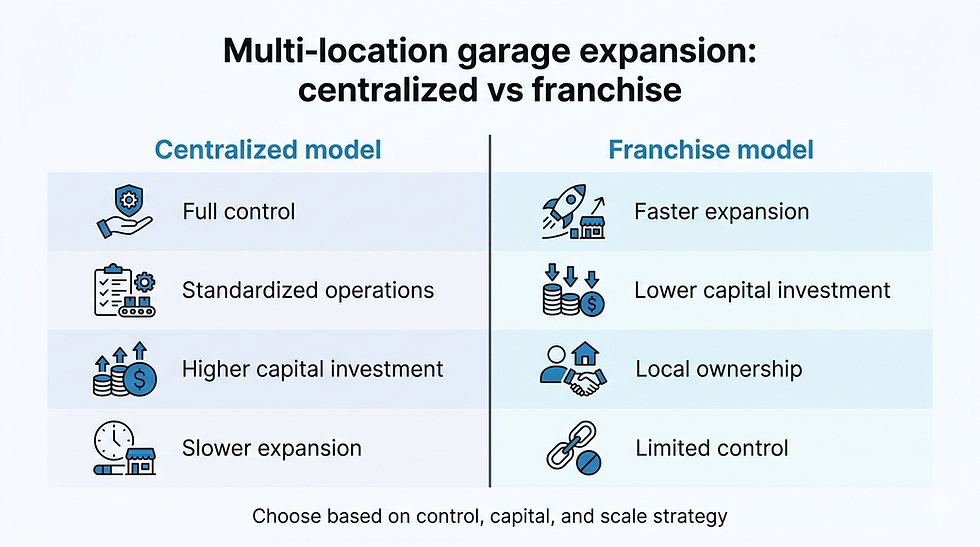
Factor | Centralized model | Franchise model | Hybrid model |
Control | High | Medium | High in owned locations, controlled in partner locations |
Expansion speed | Slower | Faster | Balanced |
Capital need | Higher | Lower for the brand owner | Moderate |
Service consistency | Easier to enforce | Depends on partner discipline | Requires strong systems |
Best fit | Nearby branches and premium control | Regional expansion | Core markets plus new regions |
System need | Branch visibility and reporting | Access control and compliance | Network-wide benchmarking |
Why this decision matters more than most owners expect
Garage operations are not like retail chains.
They involve:
Technician skill variability
Inventory dependency across locations
Service quality risks
Customer trust linked to execution, not just brand
In many emerging markets, the shift from unorganized garages to structured multi-location workshops is accelerating. Industry research from McKinsey automotive insights highlights how operational standardization is becoming a key differentiator in automotive services.
This makes your expansion model a structural decision, not just a financial one.
When should you choose a centralized model
A centralized approach works best when control and consistency are critical.
Choose centralized if:
You operate within a limited geographic radius
Your services require high technical precision
Your brand depends on consistent customer experience
You have capital and management bandwidth
How centralized operations work in reality
In a well-run centralized multi-location setup:
Job cards are created using the same format across all workshops
Inventory is managed centrally or with shared visibility
Technicians are assigned based on skill and availability
Service advisors follow uniform pricing and approval processes
Owners monitor performance across locations through a single system
This reduces variability and improves control.
Risks of centralization
High capital investment for each new workshop
Management dependency on the owner
Slower expansion speed
Operational bottlenecks if systems are not in place
Without proper systems, centralization leads to owner burnout.
When should you choose a franchise model
Franchising is designed for speed and scale.
Choose franchise if:
You want to expand across cities or regions
You want to reduce capital investment per location
You have a repeatable and documented operating model
You can enforce standards without direct control
How franchise operations work in reality
In a structured franchise model:
Franchise partners manage local workshop operations
Standard job cards and service processes are enforced
Reporting is shared with the central business
Supplier relationships are aligned where possible
Performance is monitored through audits and system data
This allows expansion without direct operational involvement.
Risks of franchising
Loss of direct control over service quality
Brand inconsistency across locations
Dependency on franchise partner discipline
Difficulty enforcing operational standards
Franchising without strong systems leads to brand dilution.
Centralized vs franchise: decision framework for garage owners
Step 1: evaluate operational maturity
Are your workflows documented
Are job cards consistent
Can your workshop run without your presence
If not, centralize first.
Step 2: evaluate capital vs expansion speed
Strong capital, controlled growth → centralized
Limited capital, rapid expansion → franchise
Step 3: evaluate geographic spread
Same city or nearby locations → centralized
Different cities or regions → franchise
Step 4: evaluate brand strength
Strong, trusted brand → franchise ready
Early-stage or local brand → centralize first
Step 5: evaluate management capacity
Strong internal management → centralized
Limited oversight capacity → franchise
A practical hybrid model for growing garage networks
Most successful businesses do not choose one model.
They combine both.
How the hybrid model works
Core workshops are centrally owned
Expansion into new regions is done through franchise partners
Systems connect all locations for visibility and control
This approach balances:
Control in key markets
Speed in new regions
Risk and capital efficiency
Why multi-location garage management software becomes critical at scale
A multi-location garage management system helps owners control daily operations across branches without relying only on phone calls, spreadsheets or manual updates. It should support standardized job cards, shared customer and vehicle history, branch-wise reporting, inventory visibility, technician tracking and role-based access for managers or franchise partners.
At scale, operational issues are not visible manually.
Common challenges include:
Inconsistent job cards across locations
Inventory mismatch between workshops
Lack of visibility into technician productivity
Delayed reporting and decision-making
Industry data from Deloitte automotive industry insights shows that digital standardization and process visibility are key to scaling service operations efficiently.
How a multi-location system supports both models
At this stage, software is not about convenience. It is about control.
In centralized operations
Provides real-time visibility across all workshops
Standardizes job cards and workflows
Enables centralized reporting and monitoring
In franchise operations
Maintains brand consistency through structured processes
Enables controlled access for franchise partners
Provides performance visibility without micromanagement
In hybrid models
Connects owned and franchised workshops
Enables benchmarking across locations
Supports scalable operations without fragmentation
Conclusion: structure defines scale in multi-location garage expansion
Multi-location garage expansion is not just about opening more workshops. It is about choosing the right structure for how your business will operate at scale.
Centralization gives you control and consistency. Franchising gives you speed and capital efficiency. A hybrid approach allows you to balance both as your network grows.
The key is not just choosing a model. It is ensuring that your operations can run across locations without dependency on you.
At this stage, most growing garage businesses start facing challenges with visibility, consistency, and control across workshops. This is where having a structured multi-location system becomes critical.
If you want to understand how this works in practice, you can explore the Autorox multi-location garage management solution and see how multi-location operations are managed across centralized, franchise, and hybrid models.
If you are evaluating your next step, it is worth seeing how your current setup would function at scale.
You can book a free demo to walk through real operational scenarios and understand how multi-location garage expansion can be managed with clarity and control.
Click on “Book a Free Demo” to explore how your garage expansion can be managed with clarity and control.
No commitment. No long sales call. Just a real look at how the platform works for a workshop like yours.
Frequently asked questions
What is the best model for multi-location garage expansion
There is no single best model. Centralized models are ideal for control and consistency. Franchise models are better for rapid expansion with lower capital investment. Many businesses use a hybrid approach to balance both.
Can a garage business shift from centralized to franchise later
Yes. Many businesses start with centralized operations to build strong processes and later expand through franchising once systems and brand standards are well established.
Why do garage businesses fail during expansion
Common reasons include lack of standardized workflows, poor visibility across locations, inconsistent service quality, and choosing an expansion model that does not match operational readiness.


Comments